
 English
 中文简体
中文简体 Español
A straw sports water bottle earns repeat orders from distributors for one reason buyers rarely mention up front: the mouthpiece either survives daily gym-bag abuse or it doesn't, and no amount of body-design customization compensates for a straw valve that cracks after a few weeks of use.
Straw Valve Geometry Determines Field Failure Rate
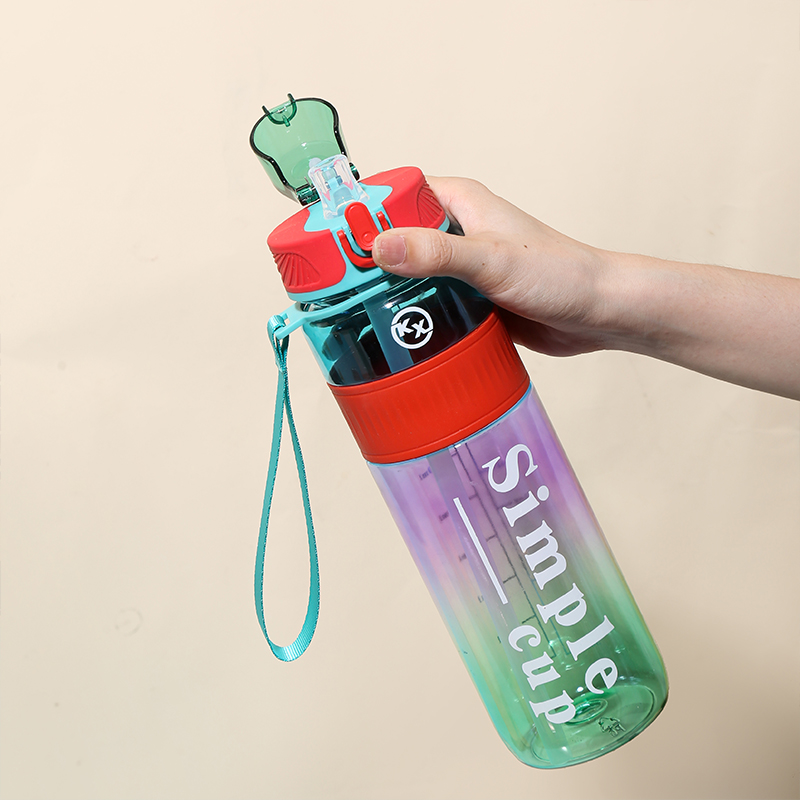
Most quality complaints on a straw sports water bottle trace back to the small silicone or TPE valve at the straw tip rather than the bottle body itself. A valve molded with insufficient wall thickness splits along the slit line after repeated bite-and-release cycles, while a valve engineered with reinforced flex points at the slit base holds up through significantly more cycles before showing wear. Buyers sourcing for gym or fitness retail channels — where the bottle gets opened and closed dozens of times daily — should request cycle-testing data on the valve specifically, since body-level drop testing does not reveal this failure mode at all.
Straw Length and Bottle Height Need to Match Exactly
A straw cut even a few millimeters short relative to bottle height leaves residual liquid pooling at the base that becomes difficult to clean and can develop odor over repeated refills. Manufacturers producing a straw sports water bottle across multiple capacity variants — 750ml versus 1000ml, for example — need separate straw-length tooling for each variant rather than trimming a single standard length by hand, since hand-trimmed straws introduce inconsistency across a production batch that shows up as customer complaints about residual water at the bottom.
Material Selection Affects Taste Transfer, Not Just Durability
Polyethylene (PE) and polypropylene (PP) are the two dominant resins used for straw sports water bottle bodies, and the choice affects more than impact resistance. PE tends to resist flavor and odor absorption from repeated use with flavored electrolyte mixes better than lower-grade PP, which matters directly for buyers targeting sports nutrition retail channels where bottles are frequently used with powdered mixes rather than plain water. A PE sports water bottle manufacturer working with food-grade virgin resin, rather than reground or mixed-grade material, produces bodies that resist taste transfer more consistently across a production run.
|
Component |
Standard Build |
Reinforced Build |
|
Straw valve wall thickness |
Thinner, lower cycle tolerance |
Reinforced at flex points |
|
Straw length tooling |
Single length across capacities |
Capacity-matched tooling |
|
Body resin |
Mixed-grade PP |
Virgin-grade PE or PP |
|
Cap-to-body seal |
Single O-ring |
Dual-seal gasket system |
Cap Sealing Mechanism Is Where Leaks Actually Originate
Buyers troubleshooting leak complaints on a straw sports water bottle often inspect the straw valve first, but the cap-to-body thread seal is a more common source of slow leaks during transport or when the bottle is carried sideways in a bag. A leak-resistant bottle cap design using a dual-seal gasket — one seal at the thread interface and a secondary seal at the straw base — outperforms a single-O-ring design under the lateral pressure that occurs when a bottle is packed tightly in a gym bag alongside other items, which is a common real-world condition that static leak testing on an upright bottle does not simulate.
Custom Mold Development Timelines Depend on Cavity Complexity
Buyers requesting a fully custom bottle silhouette — rather than a color or branding change on an existing mold — should expect a longer development timeline tied directly to cavity complexity, since a straw-mouth bottle requires precision tooling for both the body cavity and the smaller straw and valve components. A custom sports bottle mold program handling both body and straw-assembly tooling under one roof typically shortens the overall development cycle compared to sourcing body tooling and straw-component tooling from separate vendors, since design revisions on one component often require corresponding adjustments to the other.
Certification Requirements Track the Straw Assembly, Not Just the Bottle Body
Food-contact safety certification for a straw sports water bottle needs to cover the straw and valve assembly separately from the bottle body, since these are frequently molded from different materials and may be sourced from different sub-suppliers even within a single finished product. Buyers importing into regulated markets should confirm that certification documentation explicitly lists the straw and valve materials rather than referencing only the main bottle resin, since a compliance gap in the smaller assembled component is a common source of import delays that buyers discover only after a shipment has already been produced.
Production Consistency Across Color and Pattern Variants Requires Separate Quality Checks
A straw sports water bottle line offering transparent, gradient, and solid color variants faces different quality-control considerations for each finish type, since gradient coloring techniques introduce more opportunity for batch-to-batch shade variation than a single solid color run. Manufacturers running dedicated inspection checkpoints for gradient and multi-color variants — checking shade consistency against a reference sample rather than relying on the same visual check used for solid colors — catch this variation before it reaches a buyer's incoming inspection, where inconsistent gradient shading across a bulk order is a frequently reported quality complaint in this product category.
